Posts

Showing posts with the label Quilting Tips &Tricks

How to Make Multiple Half Square Triangles

Image
Make your HST blocks faster with these two simple methods for making multiple HST squares. 4-in-1 HSTs Instructions  Place squares right side facing.  Stitch 1/4 inch around the outside of the squares.  Make pencil lines dividing the squares from corner to corner.  Cut along these two lines.  Flip HST and press. Square Up if necessary. 8-in-1 HSTs  Instructions  Place squares right side facing.  Draw a line from corner to corner.  Stitch 1/4 inch away from the lines you drew.  Make pencil lines dividing the squares in four parts.  Cut along these two lines.  Cut from corner to corner being careful not to cut the stitch line.  Flip HST and press. Square Up if necessary.

Rescue Your Quilts! Fix & Prevent Fabric Bleed

Image
One of the most disappointing things that can happen to a quilter is fabric bleed. We spend long hours cutting and piecing our precious creation. So, when it comes out of the wash with colours bleeding, it can be devastating. I've been working on a red and white Christmas quilt lately and wanted to prevent this disaster before it happened. These are some of the tip and tricks I gathered for preventing and fixing quilt bleed. PREVENTION Prewash your all your coloured fabrics before cutting them up. I never did this until I started reading about other people's guilt bleed nightmares. When your quilt is finished, wash it alone in cold water.  Add 1 cup of salt to the wash with a mild laundry soap. I use Woolite®   Commercial "colour catchers" sheets are another option. These are laundry sheets you put in your wash load to prevent colour runs. There are  several on the market  you can try. FIXING If there are only a few spots of bleed on white fabric, spray the area...

Quilting with White Fabric: Pros & Cons

Image
White background fabrics make stunning quilts. The high contrast makes the colours pop. However, there are a few pitfalls when using white fabric that can be frustrating and even ruin your quilt. I made this featured quilt for my mother-in-law and almost didn't give it to her. But, I was in a crunch for time so I decided to gift it to her anyway and hope she didn't notice too many of the flaws. If she did notice, she never said anything. TIPS FOR QUILTING WITH WHITE FABRIC 1.  USE A LIGHT COLOURED BACKING FABRIC Because I was in a hurry, I used the quilt-as-you-go method to assemble this quilt. To make it "reversible" I used a variety of scrap layer cakes for the backing. I don't know if it was the batting ( Hobbs Heirloom Fusible White Cotton ) but the coloured background, as you can see below, showed right through to the front! Try using light coloured backing when using white. 2.  BUY ENOUGH WHITE FABRIC FROM THE SAME BOLT When you buy your white fabric, purcha...

Make Super Easy Checkerboard Blocks - SCRAP BUSTER!

Image
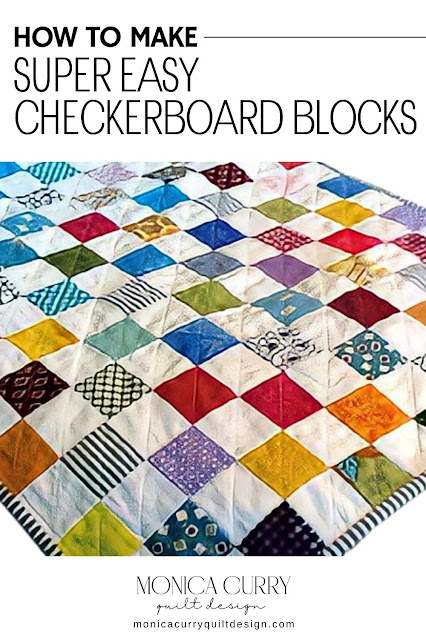
INSTRUCTIONS I discovered this technique for making scrap checkerboard blocks several years ago. I used it to make my grand-niece a doll quilt (above). With these few easy steps, the results are so worth it. When you're finished, every square will be aligned perfectly and you'll have a strong base to join the blocks so they won't stretch out of shape. Finished Block: 12"x 12" (30 cm x 30 cm)) 1.  First, you'll need a non-woven, lightweight, single-sided fusible interfacing. I purchased this very inexpensive one on Amazon . 2.  Cut [18] 2½-inch (6 cm) colour squares and [18] 2½-inch (6 cm) light colour squares. 3.  Cut [1] 13" x 13" (31 cm x 31 cm) square of interfacing. 4.  Place squares 1/2" from the edges on the adhesive side of the interfacing. Butt together the squares as shown below alternating between light and dark colours. 5.  Place a piece of cotton over the squares and press to adhere them to the fusible web. 6. Fold the first row righ...

How to Square Up Hourglass & Pinwheel Blocks: No special ruler required!

Image
This post is a supplementary tutorial for the Quick Block Calculator . When using the shortcut methods to make Hourglass and Pinwheel blocks, you often have to " square up " the block to the correct size you need. If these blocks are not squared up properly, you will end up with very wonky looking squares that will only be good for the scrap pile. In this post, I'll show you a simple method for squaring up Hourglass, Pinwheel, and Half Square Triangle blocks that doesn't require a special ruler. MATERIALS Square quilt ruler at least 8" x 8". Rotary cutter Masking tape or transparent quilt ruler tape . INSTRUCTIONS Hour Glass Divide the desired block size in half, e.g. 4½"÷ 2 = 2¼" Find this number on the ruler. Place a piece of tape horizontally and vertically on the ruler to mark the center of the block. Line up intersecting point of the tape with the center of the block. Line up the 45º angle with angle of the block. 6.  W...

How to Make Quilted Bag Straps

Image
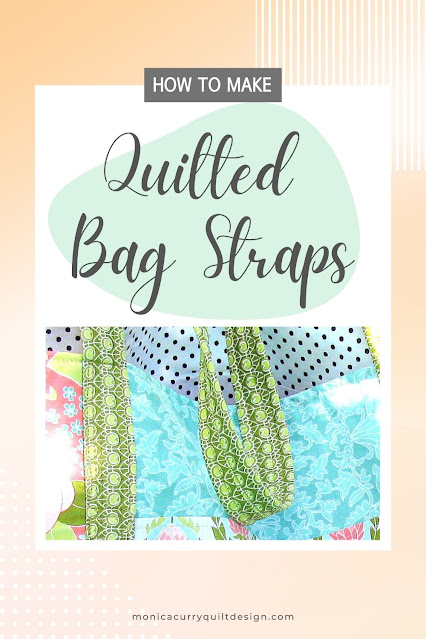
Apple Cider Market Tote aka Winslow Market Tote I first saw this tote pattern in the 2018 issue of Make It! Patchwork. It was designed by Kathy Mack and was showcased on the Quilting Arts TV Episode #601. It was originally featured as the Winslow Market Tote and has since been renamed the Apple Cider Market Tote . Apple Cider Market Tote made by Monica Curry Pattern Design by Kathy Mack I haven't made many bags, but I fell in love with this one as soon as I saw it. I wasn't sure, however, what fat quarters to use for it. When I finally dug through my stash, I found the perfect fabric for this tote ─  Into the Garden by Amanda Herring for Riley Blake. I bought this fat quarter bundle several years ago and loved it so much I didn't want to cut it! I also wanted to make pretty matching straps for this bag, but I wasn't sure how to make bag straps. I heard you could use quilt batting for straps and thought that this would be a great way to use up my batting scraps. After...

How to Make Flange Quilt Binding

Image
I love flange quilt binding. It gives quilts an elegant and finished look. I don't use it on all my projects, but sometimes a quilt needs that extra pop. Flange binding takes a little extra work, but it's well worth the effort when you see the finished result. I made the following tutorial as comprehensive as possible and hope it will help you give flange binding a try. INSTRUCTIONS 1)  CALCULATE THE LENGTH OF BINDING YOU WILL NEED FOR YOUR QUILT EXAMPLE: Finished quilt size = 54" × 60" (54" × 2) + (60" × 2) + 10" = 238" (10" extra is added for finishing the binding).  (238" ÷ 36") = 6.6 yards You will need 6.6 ≈ 7 yards of binding for a 54" × 60" finished quilt.  2)  WIDTHS TO CUT FOR FLANGE AND MAIN COLOUR STRIPS Decide on a binding width you need. Use the chart below to get the widths to cut the strips for main colour and the flange. 3)  ASSEMBLING & ATTACHING BINDING Sew both strips together lengthwise with a 1/4...

How to Accurately Cut Fabric for Foundation Paper Piecing

Image
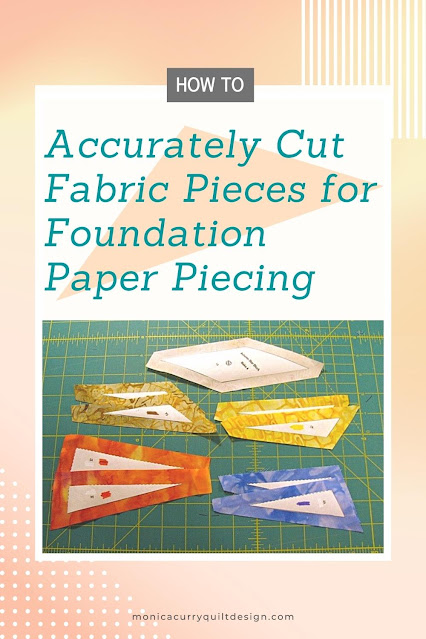
I love foundation paper piecing (FPP), but one of the most frustrating problems I had when I was a newbie was coming up short. I would be happily piecing my block, go to flip the next section to press it, and crap! It would be too short or too thin or both. Even worse, I'd be pressing a finished block and find a "hole" at a seam where a piece came up short...ugh! I eventually discovered a method that has worked great for me. I first saw this technique in Simply Amazing Spiral Quilts by RaNae Merrill. I modified it slightly by using freezer paper. It's a simple and foolproof method for cutting your FPP fabric pieces. This method is especially great for when you have multiples of the same block. INSTRUCTIONS YOU WILL NEED Foundation piecing template that has been mirrored. 8½" x 11" sheet of freezer paper Scissors Rotary cutter Quilting ruler Fabrics for your block Coloured pencils or markers to match your fabrics. 1. Print your template on the dull s...